We have recently completed our second trip of 2026 – a wonderful exploration of Morocco’s fossils and geology
Starting in the vibrant city of Marrakech, we journeyed over the High Atlas Mountains, across vast desert landscapes and into the fossil rich Anti Atlas, before returning via the remarkable M’Goun Geopark. Along the way, we were treated to some truly exceptional fossil sites – trilobites, goniatites, crinoids and orthoceras – and gained a real appreciation for the skill and patience of the fossil miners and preparators who bring these ancient specimens to light.
Travelling outside our usual November dates gave the trip a completely different feel. Snow capped peaks, flowing rivers and unexpected greenery added a fresh perspective to landscapes we thought we knew well. As always, Morocco proved itself to be one of the most geologically diverse and visually striking destinations on Earth.
We’ve picked our fifty favourite photos from the trip, captioned them, and we’re sharing them here for you to enjoy.
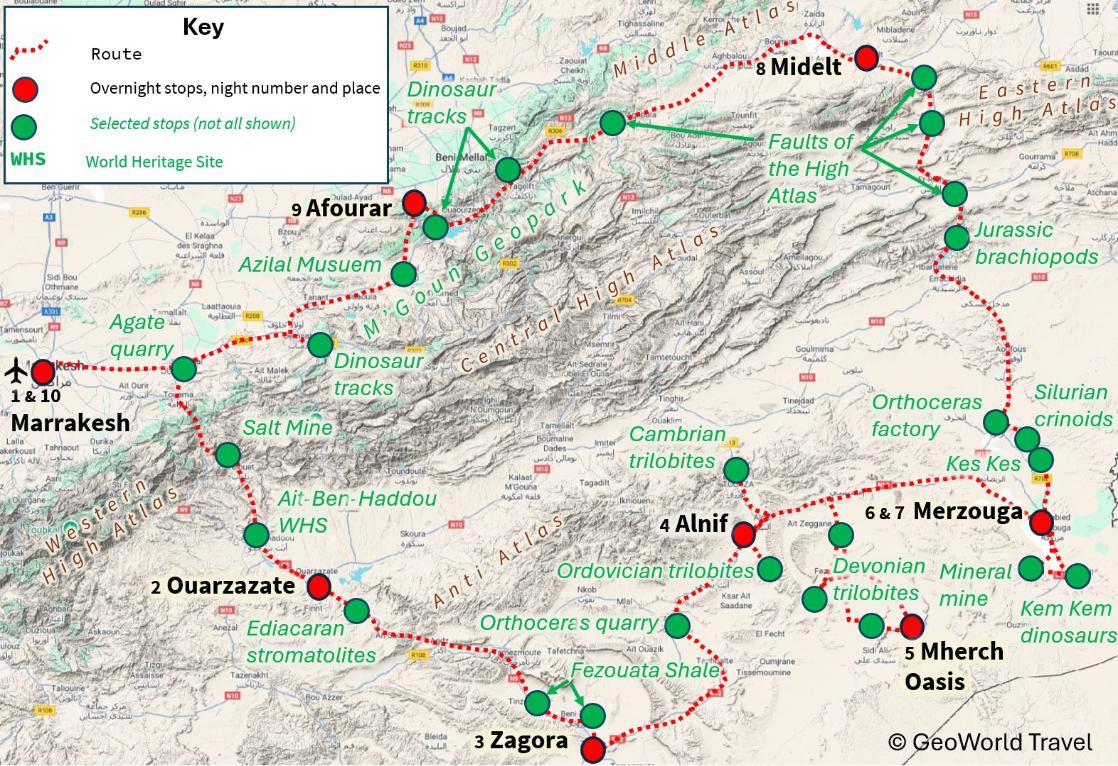
Route map of GeoWorld Travel’s ‘The Trilobites Sahara Kingdom’ tour
Day One: Arrival in Marrakech
We arrived into the historic city of Marrakech, a World Heritage Site, where the group came together ahead of the journey south.
Day Two: Crossing the High Atlas Mountains
Leaving the plains behind, we climbed into the High Atlas, stopping at agate mines, major fault zones and spectacular viewpoints. Highlights included ancient rocks thrust over one another and the iconic Kasbah Aït Benhaddou.
Left: Inside the Telouet Salt Mine. The mine is on the old Marrakech-Ouarzazate-Timbuktu road. In the 11th century, the salt from this mine was literally worth its weight in gold! This salt mine also lies on the Triassic/Jurassic boundary and has the same Triassic lavas in its vicinity as the Sidi Rahal quarry.
Top right: Part of a Triassic aged basalt cooling column, which contains an agate. The agate has formed by water precipitating SiO2 in vesicles (holes) left by gases that were in the magma. This is in the Sidi Rahal agate quarry.
Bottom right: A fault recently exposed in a new road cut in the South Atlas Fault Zone. Yellow/red coloured Triassic rocks can be seen sliding past dark coloured Ordovician-aged sedimentary rocks
Left: 570ma old stromatolites, making them Precambrian in age, from the Ediacaran period of the Neoproterozoic. They occur in the Ouarzazate volcano-sedimentary supergroup which preserve a record of both explosive volcanic activity and effusive lava flows. The stromatolites grew around the shore of ponds in this volcanically active area.
Right: View from the Tizi-n-Tinififft Pass with the Ouarzazate Solar Power Station in the distance. This is also called the Noor Power Station, and it is the world’s largest concentrated solar power plant. The tower which can be seen is part of Noor 3, and incorporates mirrors mounted horizontally on platforms which are supported by 10m columns. Each platform is roughly the size of a tennis court, and the panels follow the light, reflecting it to a 250m tall solar tower.
Left: Lahcen Ben Moula with members of the GeoWorld Travel group at the Ben Moula diggings in the famous Fezouata Shale Lagerstätte. This is one of the world’s most important fossil sites with exceptional soft-bodied preservation of a fauna that resembles the Cambrian Burgess Shale in Canada, preserved alongside the more advanced Ordovician fauna. Over 1,500 non-mineralised specimens have been recovered from formations here.
Right: Members of the GeoWorld Travel group examine fossils that have been recently excavated at the Ben Moula diggings in the Fezouata Shale Lagerstätte.
Left: A photograph of a marrellid arthropod. This is one of several types of creature that have been found both here at Fezouata and also in the famous Cambrian Burgess Shale in Canada.
Right: A river flowing at the Serdrar Orthoceras Quarry. Ordinarily, no river flows here, but a few hours before our arrival, there had been a heavy thunderstorm, resulting in the temporary appearance of this river.
Day Three: Stromatolites and the Fezouata Lagerstätte
A day of deep time. We explored 600 million year old stromatolites before visiting the world famous Fezouata Lagerstätte, home to exceptionally preserved soft bodied Ordovician fossils.
Left: Aligned orthoceras (Arinoceras & Temperoceras), possibly a death assemblage. These fossils are Silurian (Ludlow, Ludfordian) in age. Orthoceras can be found in fossil shops all over the world – as plates, coasters, tables and even toilets! Many of these will have come from this quarry.
Top right: A trilobite being prepared at Mertou Trilobites, near Alnif.
Bottom right: A group of trilobites in the process of being prepared at Mertou Trilobites, near Alnif.
Left: Members of the GeoWorld Travel group examining prepared fossils at Mertou Trilobites, near Alnif.
Right: A photograph showing the margin of the Alnif Glacial Tunnel Valley. At the end of the Ordovician, Morocco lay under a huge ice sheet and flowing under the ice was a melt river. This river carved a valley that cut through the layers shown in this photograph; this valley was then infilled with sediments. These sediments can be seen in the left side of this photo.
Left: The GeoWorld Travel group examining trilobite diggings at at Tizi n’Tfarkhin on Jbel Ougnate, where large yellow coloured middle Cambrian trilobites, such as Cambropallas and Paradoxides, are extracted.
Right: Brahim, in his shop, displaying a Dicranurus monstrous which he has prepared. This fossil features on the front of the Fossiles du Maroc book, also shown in the photo.
Left: A Calymene trilobite being extracted from rock from the Ktaoua Formation of the Upper Ordovician at Jebel Tiskouine. These trilobites are most commonly referred to as Calymenes or ‘mud bugs’, but they are in fact mostly Copocoryphe. This trilobite has been stocked in the fossil shops of the world for over 20 years and 15 million specimens have been sold.
Right: The GeoWorld Travel group at El Atchana. This is a site where a lot of well-known Devonian trilobites are extracted. The Ihander Formation outcrops here, which is Pragian (Devonian) in age. There are two different fossil horizons which are named after their most famous trilobites: Dicranurus & Kolihapeltis.
Day Four: Orthoceras Quarries and Trilobite Workshops
From vast orthoceras quarries to intricate trilobite preparation workshops, this was a day that connected geology with craftsmanship and human skill.
Left: Salem, friend of GeoWorld Travel and fossil miner, hard at work searching for trilobites at El Atchana.
Top right: Our most remote and atmospheric overnight stop of the tour at Mherch. This desert oasis occupies a pass through the mountains and the area is known for its rugged desert tracks, off-road routes and challenging terrain, making it popular with overland expeditions and desert adventure travel.
Bottom right: The GeoWorld Travel group standing on top of Guelb el Mherch, which is a 45m high hydrothermal mud mound or a bioherm, which grew in the Givetian epoch of the Devonian. It is made of limestone lined with a crystalline calcite. The existing desert surface is the paleo-seafloor of that time. Crinoids and corals are very abundant here and remains of placoderm fish have also been found. Also, solitary rugose corals, brachiopods, ostracods, gastropods & bivalves. Stromatoporoids & calcareous algae are absent suggesting a deep aphotic environment.
Left: A goniatite found on the desert floor near Jebel el Krabis. It is Devonian (Famenian) in age.
Right: The GeoWorld Travel group and our drivers in the desert dunes at Erg Chebbi.
Left: The ‘saw’ of a scherorhynchid shark found in Cenomanian (100ma) Cretaceous beds of the Kem Kem. These beds have revealed over 80 vertebrate taxa including dinosaurs, crocodiles, pterosaurs, scherorhynchid sharks, lung fish, bony fish, turtles, snakes, lizards, amphibians and, found in 2022, freshwater plesiosaurs. The beds have a very high ratio of carnivorous dinosaurs to herbivorous dinosaurs. It is thought the shifting deltaic conditions were not good for the plants, and instead the food chain was based on the aquatic creatures.
Right: The fossil remains at the Kem Kem are extracted from tunnels dug by fossil miners. Here, our group meet the miners at the entrance to the tunnels and examine their finds.
Day Five: Trilobite Country and Desert Oasis
In the Anti Atlas, we explored classic trilobite sites and met local miners working remote exposures. The day ended in the incredible isolation of a desert oasis under clear night skies.
Top left: Predatory dinosaurs found in the Kem Kem include Carcharodontosaurus, Deltadromeous and, most famously, Spinosaurus. This photo is of a recently found Carcharodontosaurus tooth found at the Kem Kem.
Top right: Members of the GeoWorld Travel group examine Scyphocrinites crinoids on the the Silurian/Devonian boundary, near Taouz.
Middle right: An example of the mineral vanadinite, which had just been found in a dry riverbed in front of the Filon 12 mineral mine, near Taouz.
Bottom: Elliot and a Filon 12 miner search for mineral specimens in the dry riverbed in front of the Filon 12 mineral mine.
Day Six: Reefs, Fossils and the Sahara Edge
In the Anti Atlas, we explored classic trilobite sites and met local miners working remote exposures. The day ended in the incredible isolation of a desert oasis under clear night skies.
Left: Moha takes the GeoWorld Travel group on an underground tour at the Filon 12 mineral mine. Filon 12 started life as a haematite mine, but it is now a mine solely for mineralogical specimens. Minerals found here include vanadinite, goethite and haematite.
Right: The GeoWorld Travel group enjoy an evening camel ride in the dunes of Erg Chebbi.
Left: A panoramic view of the Kess Kess mounds. Hamar Laghdad, which is also known as the Kess Kess, is one of Morocco’s best known Devonian sites. There are 40 or more carbonate mounds in a 7km line which formed on a volcano as hydrothermal mud mounds. They have been exposed by erosion and are seen sitting on their palaeosurface. Corals and trilobites used to be abundant here but have been heavily collected.
Top right: Members of the GeoWorld Travel group peer down a bell pit from which crinoid fossils from the Silurian/Devonian boundary are extracted.
Bottom right: A spectacular crinoid fossil which has been extracted from the Erfoud bell pits. On display at Fossiles d’Erfoud, a shop and gallery nearby.
Day Seven: Dinosaurs and Desert Geology
We stepped into the Cretaceous at the Kem Kem beds, where dinosaur remains including Spinosaurus can still be found, before exploring mineral mines and ancient rock sequences.
Top left: A demonstration of how a tabletop is made, at Fossiles d’Erfoud. The tabletop, made of Erfoud stone, contains orthoceras and goniatites. It was quarried from the nearby Erfoud Quarry.
Top right: A large assemblage of Middle-Cambrian-aged Paradoxides trilobites on display in the gallery at Fossiles d’Erfoud.
Day Eight: Carbonate Mounds and Atlas Crossing
A day of scale and contrast – from Devonian carbonate mounds to vast canyon views, before heading back toward the High Atlas Mountains.
Top left: Yan and Annemarie in the Ziz Valley. The red-coloured rocks are Upper Cretaceous in age. The Ziz River, flowing from the High Atlas Mountains, creates an oasis in the valley bottom, which allows the date palms to flourish. The valley is also an ancient caravan route from Timbuktu to Fez.
Top right: A panoramic view in the High Atlas Mountains where the Ait Atmane fault cuts through Jurassic-aged limestones.
Middle right: A fold in Jurassic-aged limestones, very close to the North Atlas Border Fault in the High Atlas Mountains, near Midelt
Bottom: A fossil shark tooth and a fossil ray tooth found in late Cretaceous aged phosphates, near the village of Naour, where the Middle Atlas and High Atlas mountain ranges meet.
Day Nine: Fault Lines and Dinosaur Tracks
Crossing major geological boundaries, we entered the M’Goun Geopark and discovered dinosaur trackways preserved in Jurassic rocks.
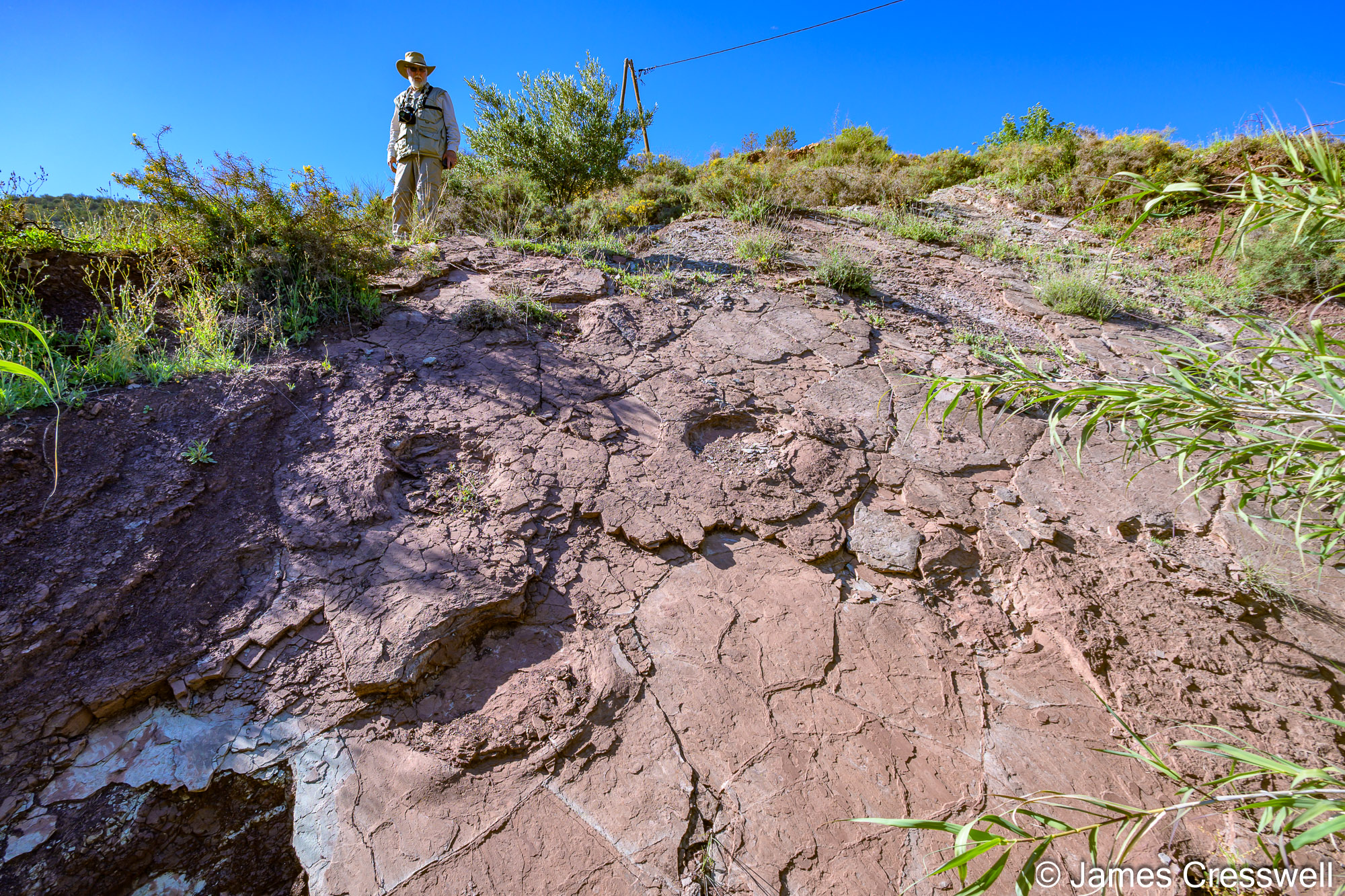
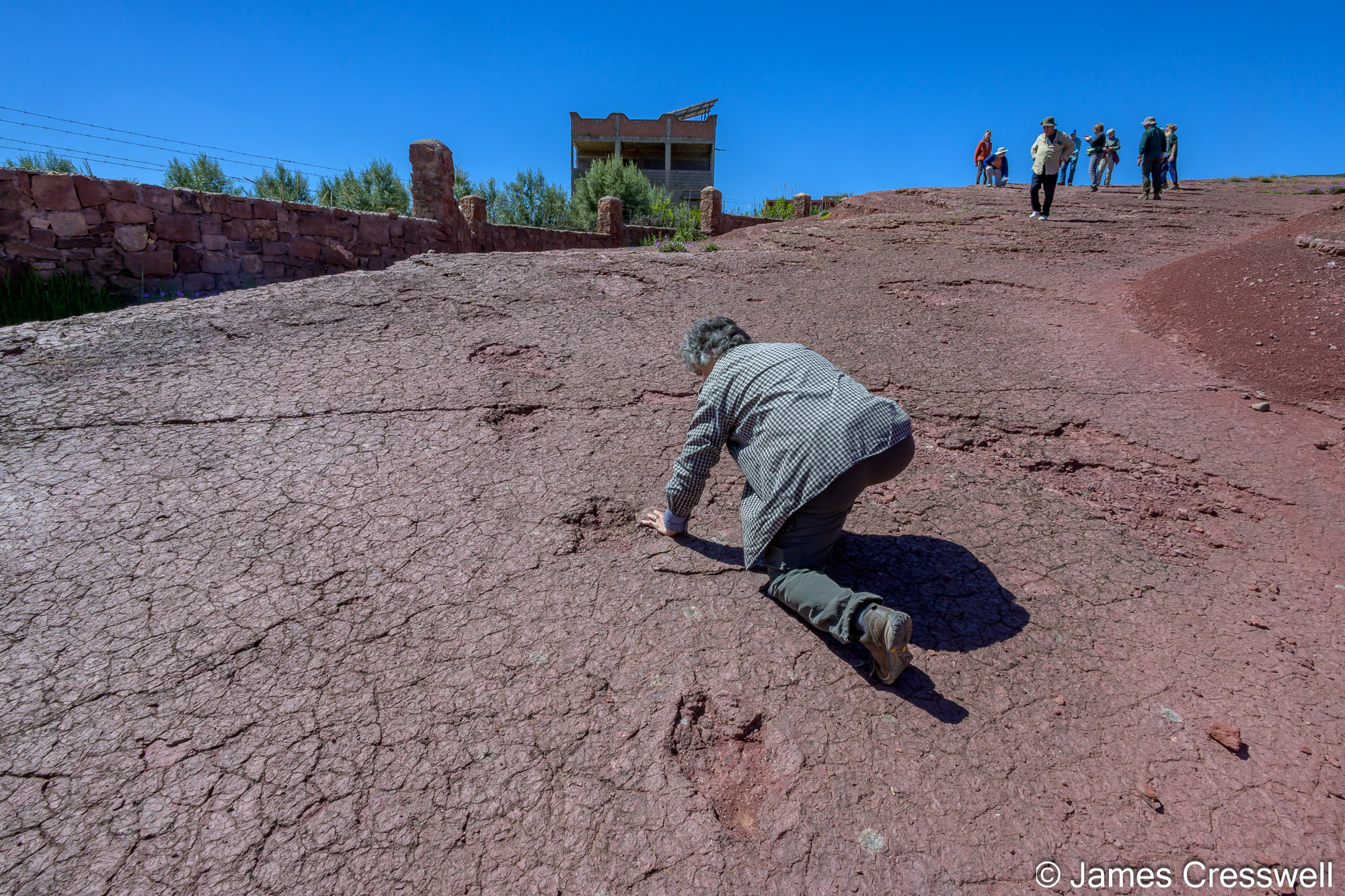
Top Left: Just above the tridactyl footprints at Bin El Ouidane, there are oval footprints (of 30-40 cm in diameter) of a large herbivorous sauropod dinosaur which lie on a red ochre silt bed.
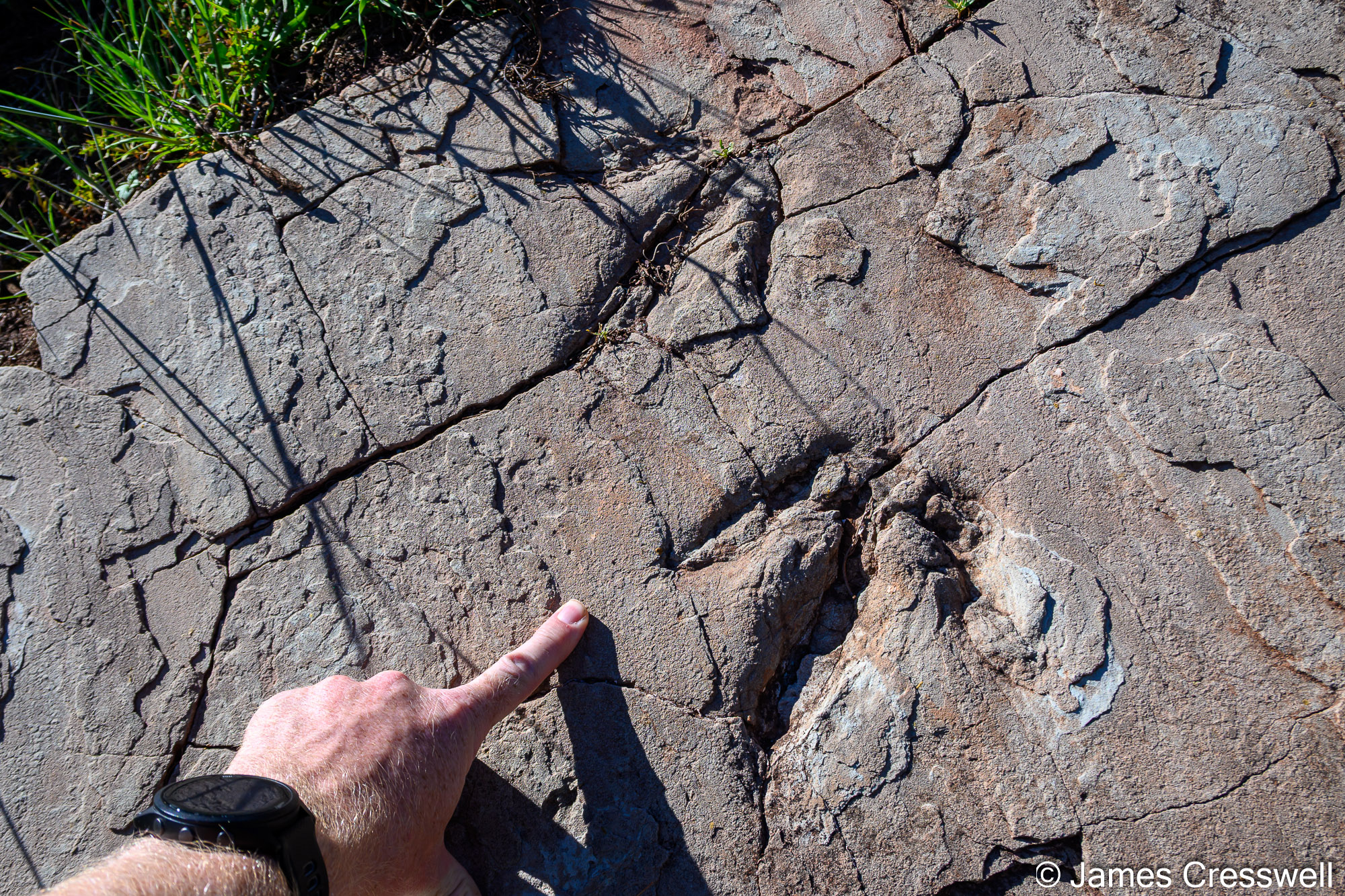
Top Middle: Tridactyl footprints from a small-sized therapod dinosaur in silt beds of the Tilouguite Formation (Bathonian-age, 165 Ma) at Bin El Ouidane.
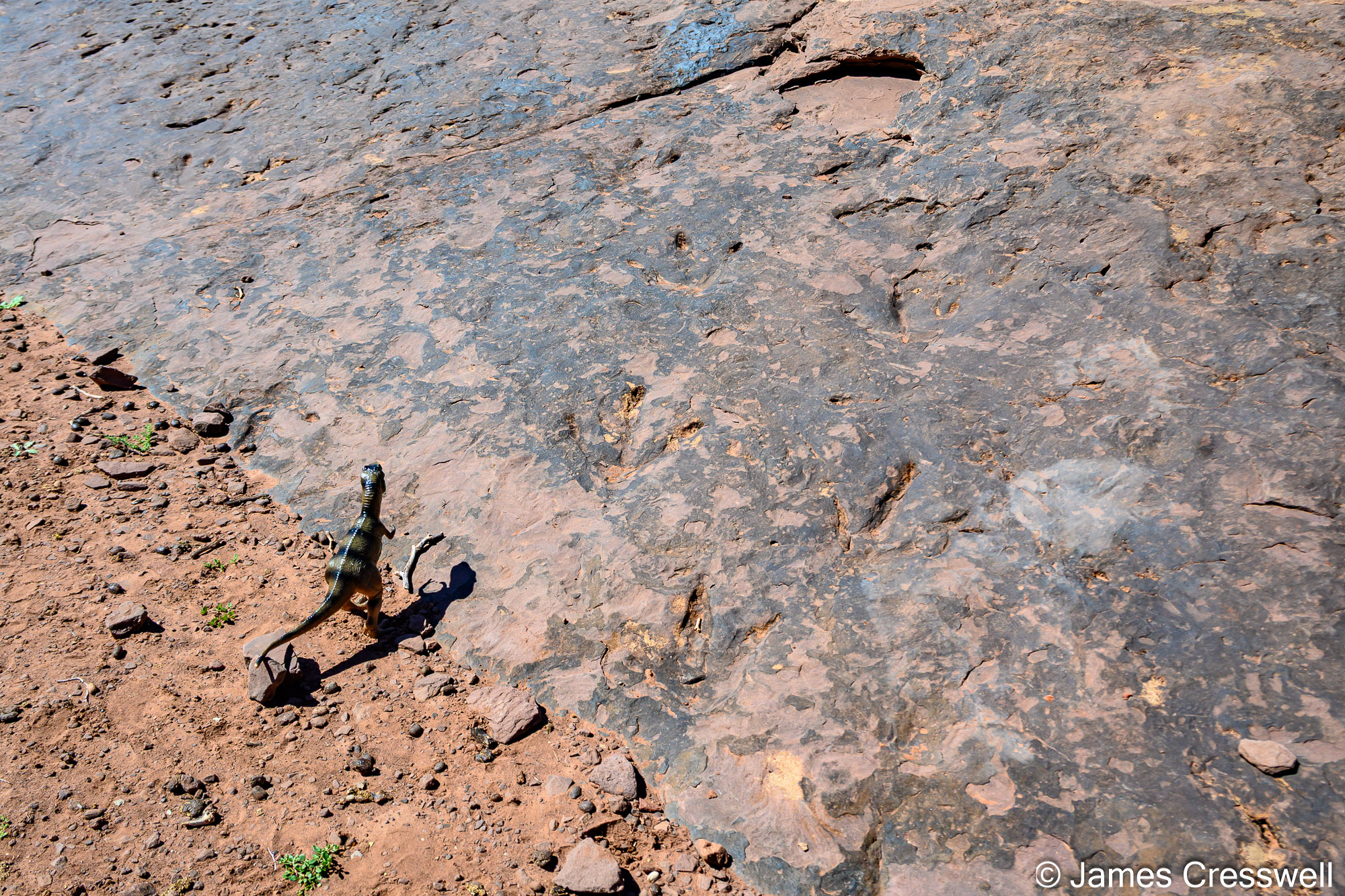
Top right: Dinosaur tracks, with a toy dinosaur for scale! These tracks are situated in the Taguelft Basin.
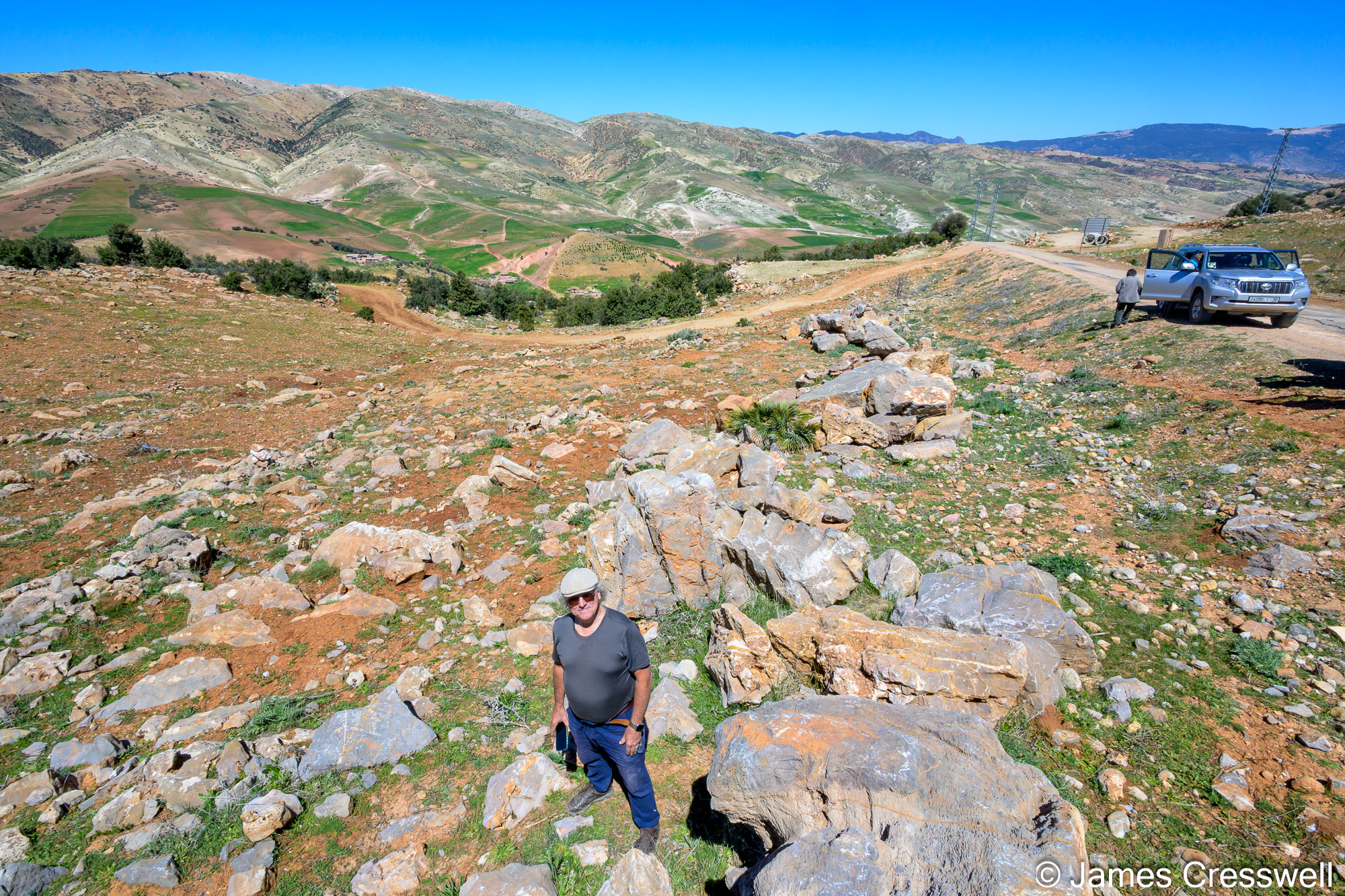
Bottom: In the valley in the mid-ground is the Aghbala-Afourar Fault, a continuation of the North Atlas Border Fault. This is where the High Atlas and the Middle Atlas Mountain ranges meet. Richard is therefore standing in the High Atlas, but the mountains in the upper part of the picture are in the Middle Atlas.
Day Ten: M’Goun Geopark and Natural Wonders
From museum giants like Atlasaurus to extensive tracksites and natural formations like Imnifri Bridge, the geopark delivered a fitting finale.
—————————
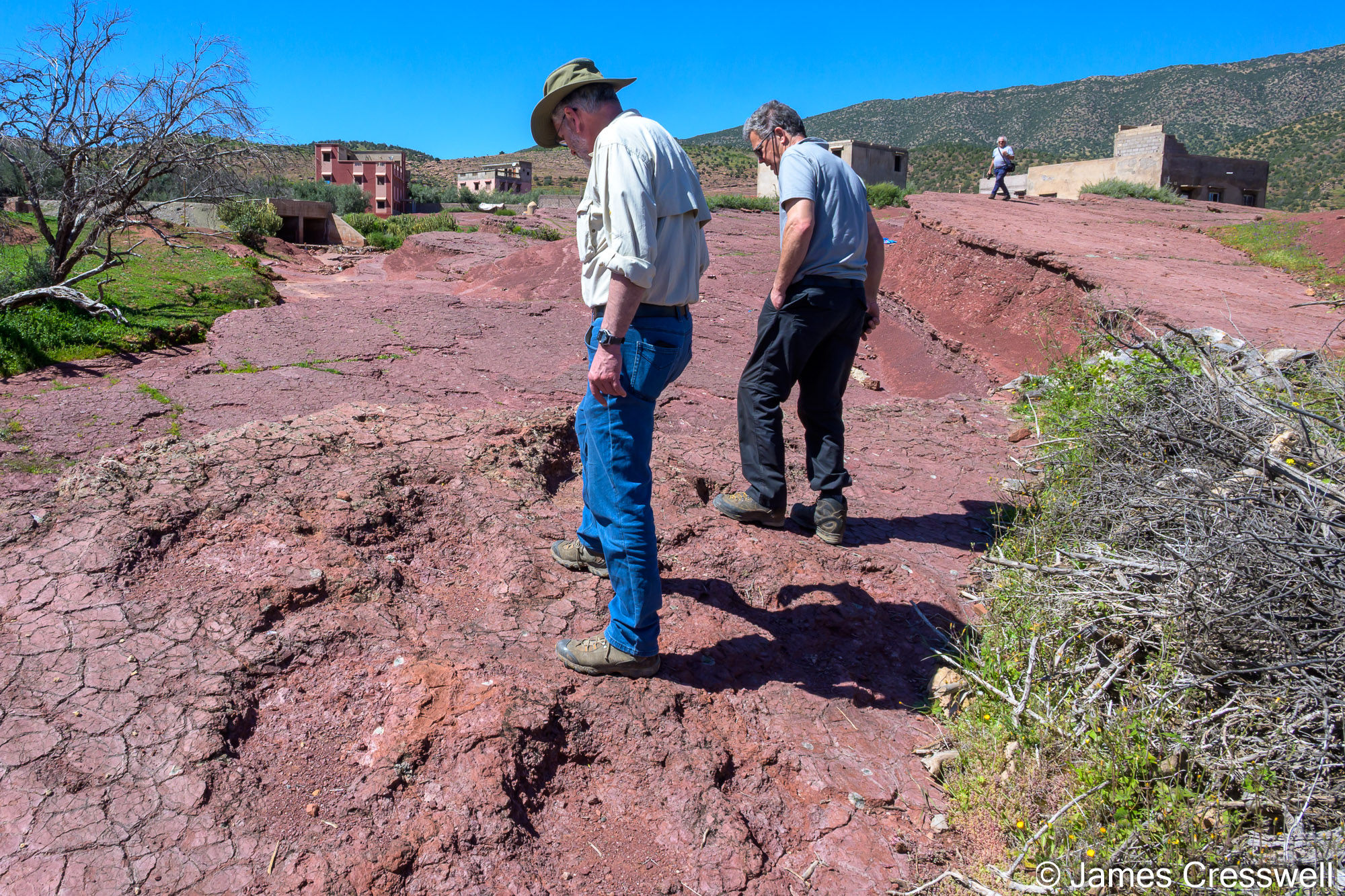
Top Left: Jeff and Tony examine dinosaur tracks at the Iroutlane-Iwariden dinosaur track site. These are medium to very large sized sauropod tracks and they include tracks of the renowned Breviparopus taghbaloutensis dinosaur, which is named after the village. In amongst these tracks, there is also a lone stegosaur track, the only known stegosaur track in north Africa.
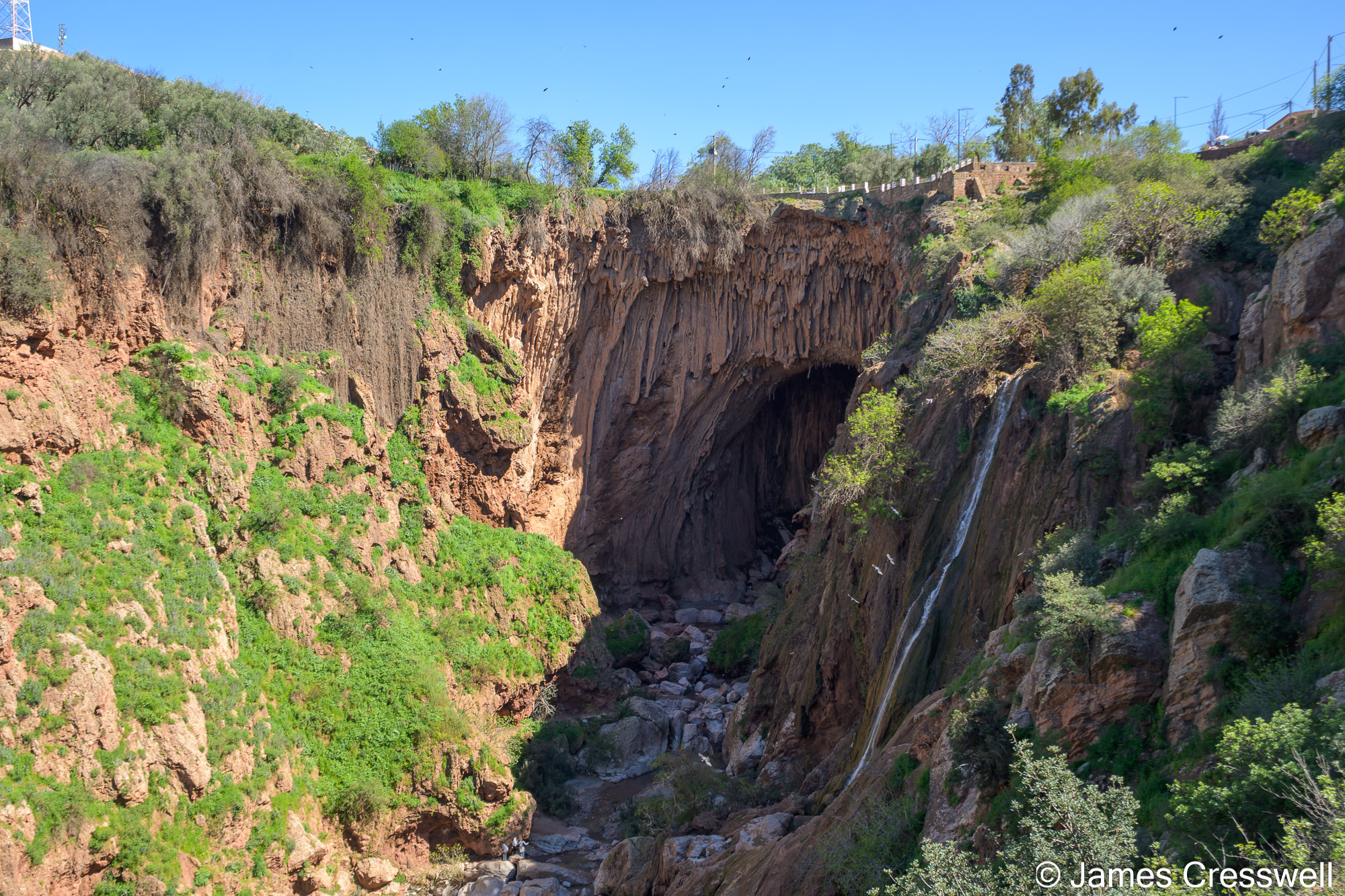
Top Middle: The Iminifri Natural Bridge. This is a collapsed cave in the Jurassic-aged limestone that has a roof of travertine. When viewed from certain directions, the opening under the bridge resembles the outline of Africa.
Top right: Gail examines Megalosaurian therapod dinosaur tracks close up. These are part of one of the largest dinosaur track sites in North Africa, the Iroutlane-Iwariden dinosaur tracks. These cover 5 sq km and contain more than a thousand footprints.
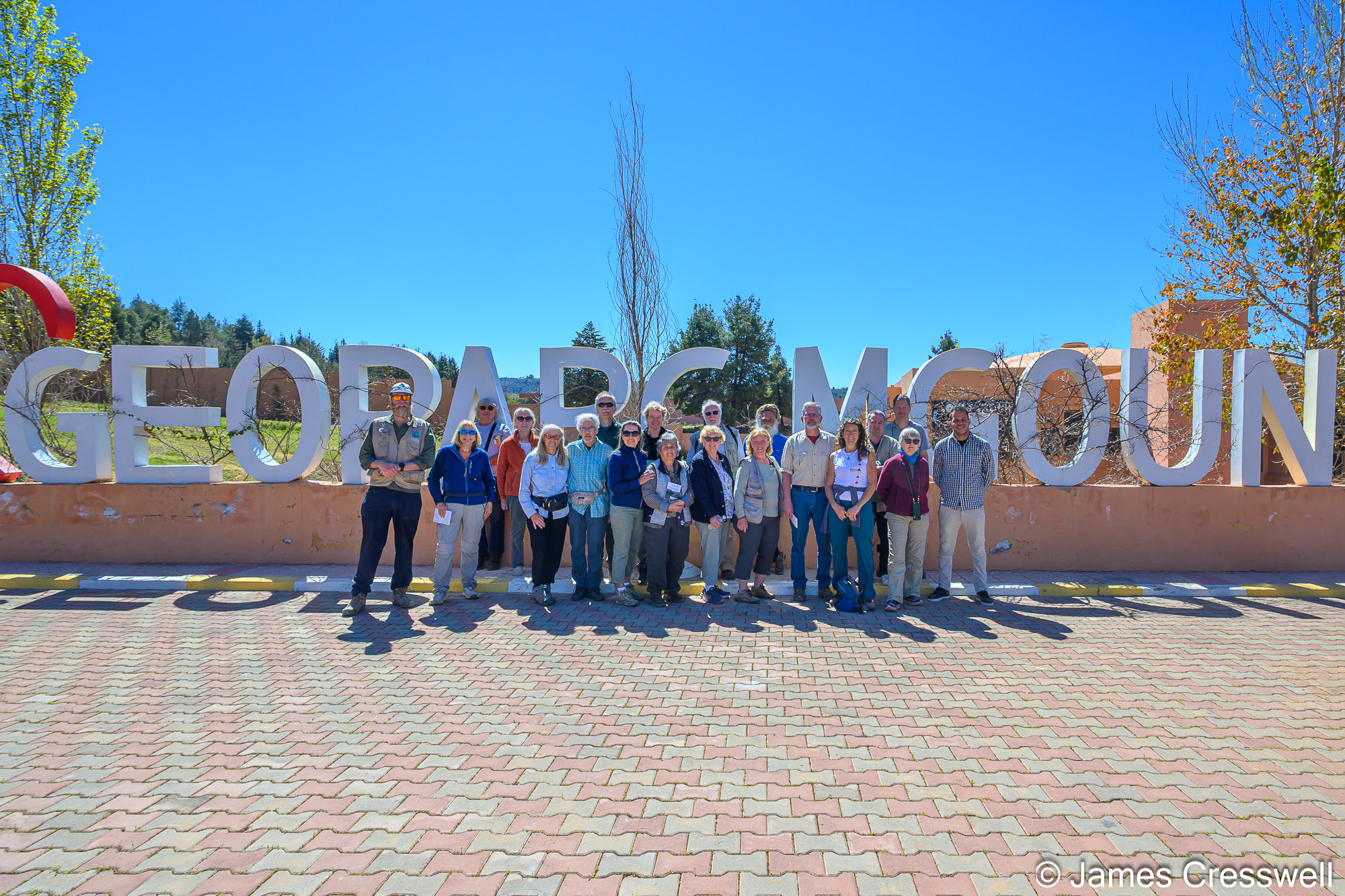
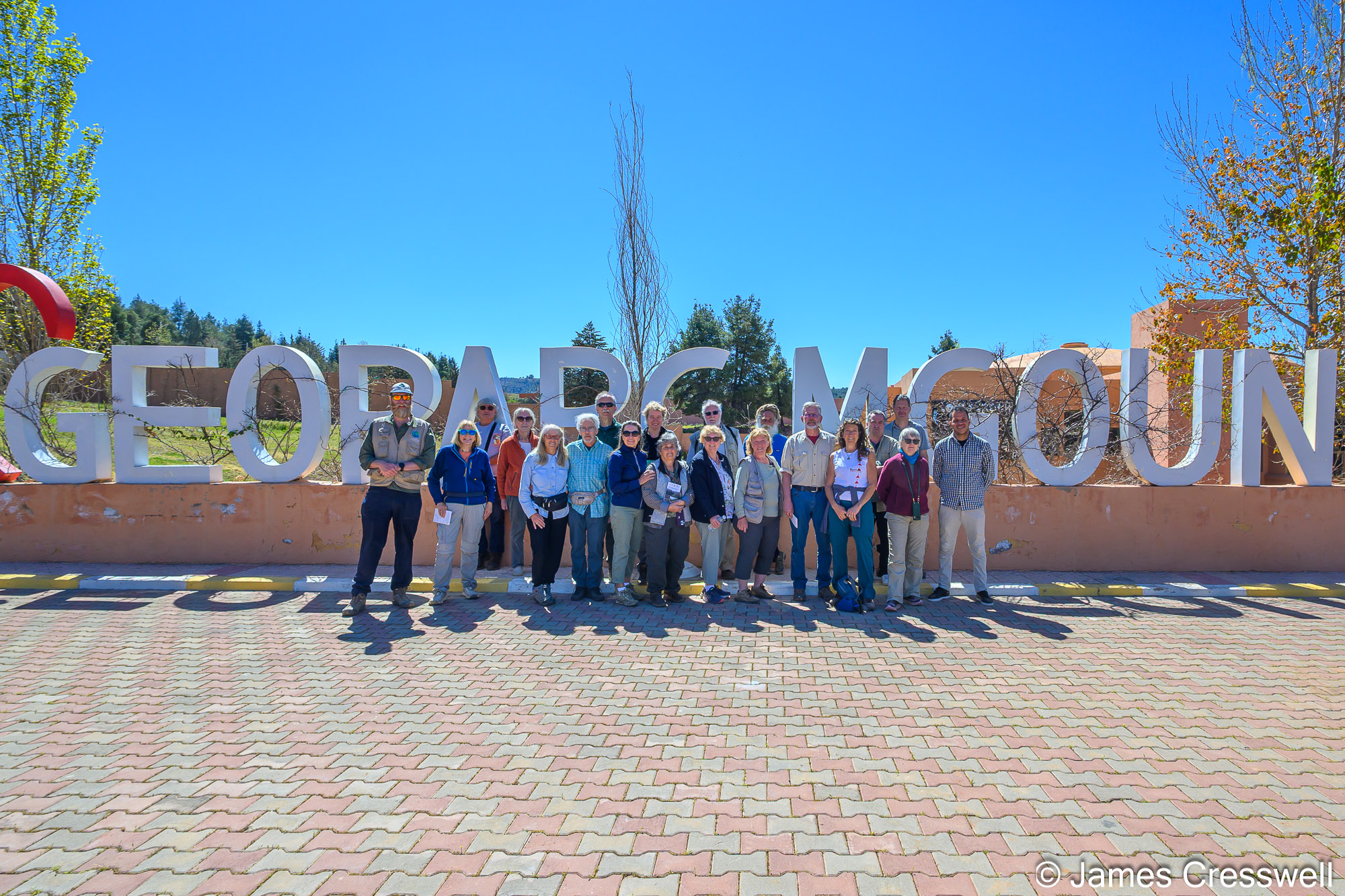
Bottom: The GeoWorld Travel group at the Museum of the M’Goun Geopark, Azilal.
From mountain building plate collisions to ancient oceans, thriving reefs and desert dunes, Morocco offers a geological story on a truly epic scale. But what makes trips like this special is not just the landscapes – it is the people, the shared experiences and the moments of discovery along the way.
This was a journey through deep time, across cultures and into some of the most remarkable environments on Earth – and one we will not forget any time soon.
We will be returning to Morocco again in November 2027, so please keep an eye on our website (Here) for further details of future trips.